Reframing “Value” in a Price-Driven Market
Above OCM is my parents' owners corporation (OC) management firm competing in a market dominated by "value" positioning. They engaged me to redevelop their proposal document, the primary document used when pitching for new buildings.
Competitor analysis showed that other firms leaned heavily on low fees and framed cost-cutting as prudence. Most proposal documents were long, dense and many were cost-focused.
Above OCM operated a higher-cost model with lower manager capacity and relatively premium service. I say relative because my analysis found that cut corners are so endemic to the property industry that total compliance with legislation is often impossible for low-cost firms, let alone decent service. This was the understanding that the Above OCM sales team had. They found that clients were really attracted to the idea of real service, with many of the most enthusiastic leads coming from clients who had already been burned by the industry.
Above OCM understood how to communicate this to their clients in conversation but their sales assets didn't convey this story. The proposal was a document aimed at demonstrating competence but it didn't communicate why that was important. I made it a cohesive argument.
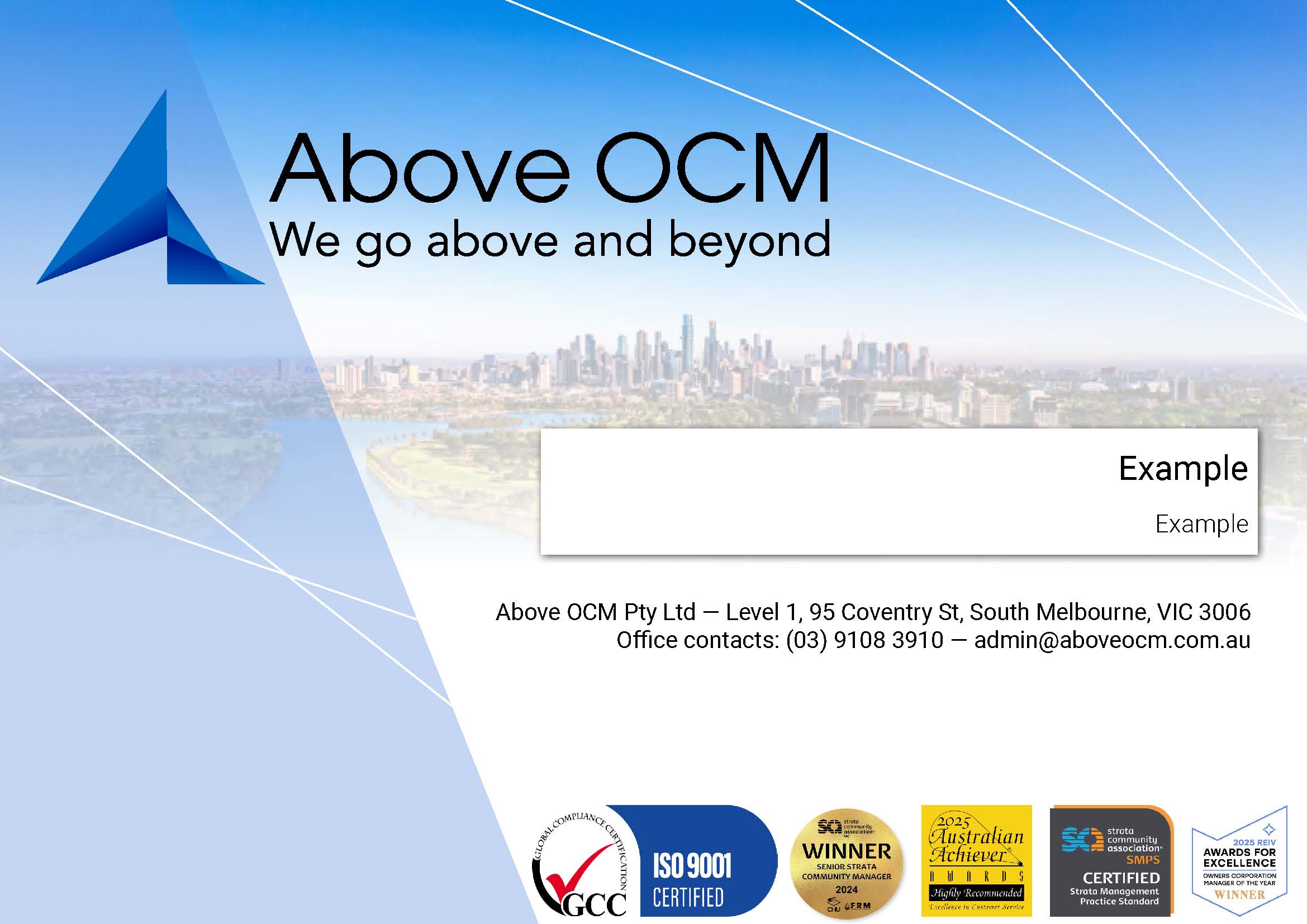
Staff faces have been removed from the spreads shown here for privacy. The full document is available on request.
OC managers are usually appointed by the OC committee rather than the entire owners corporation. Committee members are accountable to other owners and are conscious of how their decisions are perceived. I wondered why someone would take this unpaid appointment, so I sat in on meetings and researched the audience. I found that aside from protecting their own property value, they wanted to be good, responsible stewards of the community.
Low fees function as a visible signal of prudence. In this market, the word "value" had become shorthand for cost minimisation, even when that minimisation reduced service depth and increased downstream risk. Above OCM needed to convince their audience that the premium service was worth it.
Insight:
The audience bought value because it seemed prudent so I had to convince them that premium is prudent.
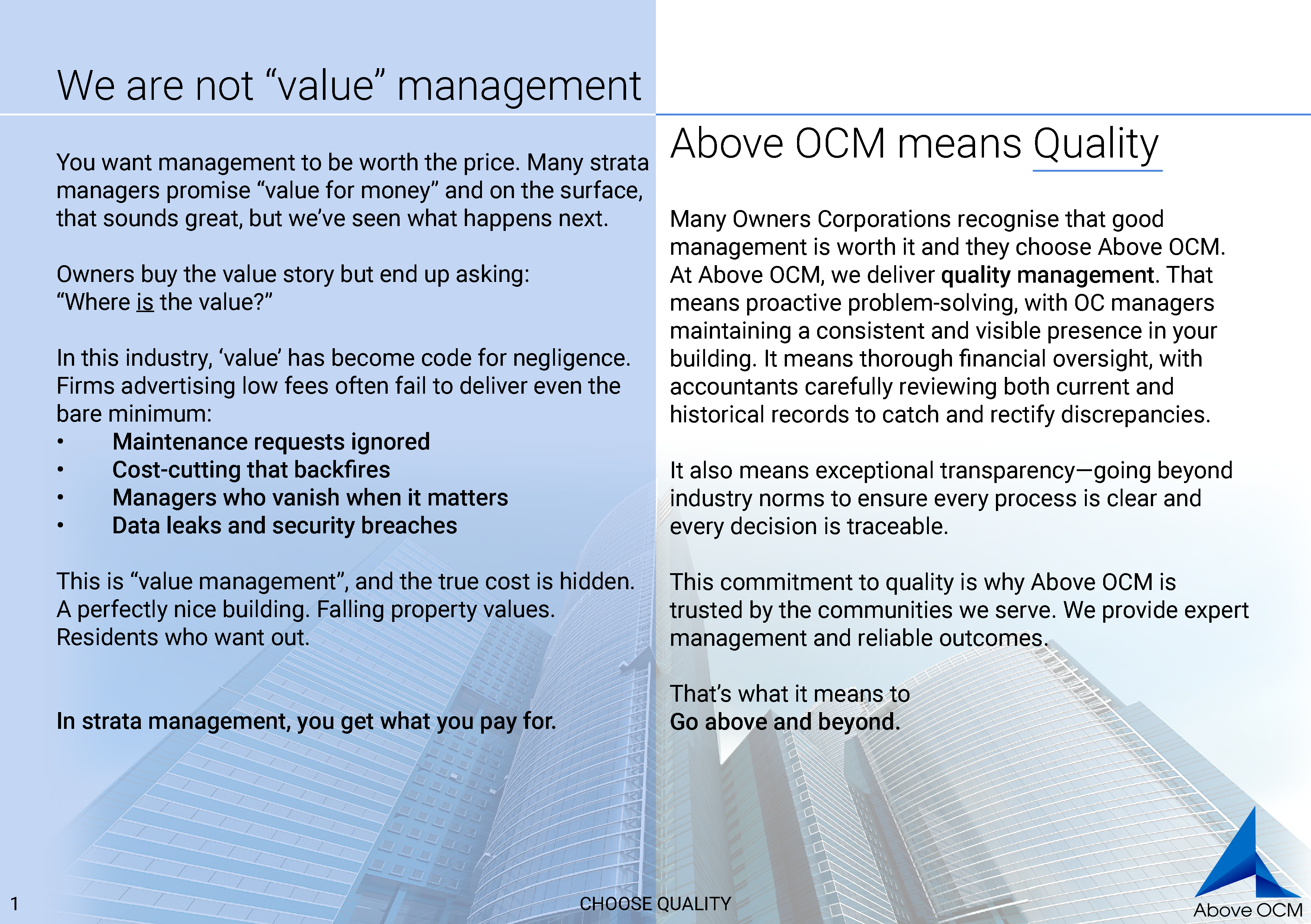
Our frame was short-term savings vs long-term responsibility. They called their service premium internally. I called it Quality.
"Value" vs Quality. Both terms imply that the option is justified, thereby legitimising the choice. I defined quality management in the document as ‘Proactive Management’, ‘Creating Community’, ‘Financial Precision’, ‘Compliance & Risk Reduction’ and ‘Digital Transparency’. These were USPs that Above OCM was already using so I turned them into a structure. The aim was to align the decision with the committee member’s self-conception as a responsible steward.
Execution:
I rebuilt the proposal from the ground up in 34 landscape pages so that it could be presented as slides or printed. The document was written with "Quality" as the central organising idea. It was broken into defined categories of proof, each supported by subcategories and specific evidence. This created a coherent argument rather than a list of services.
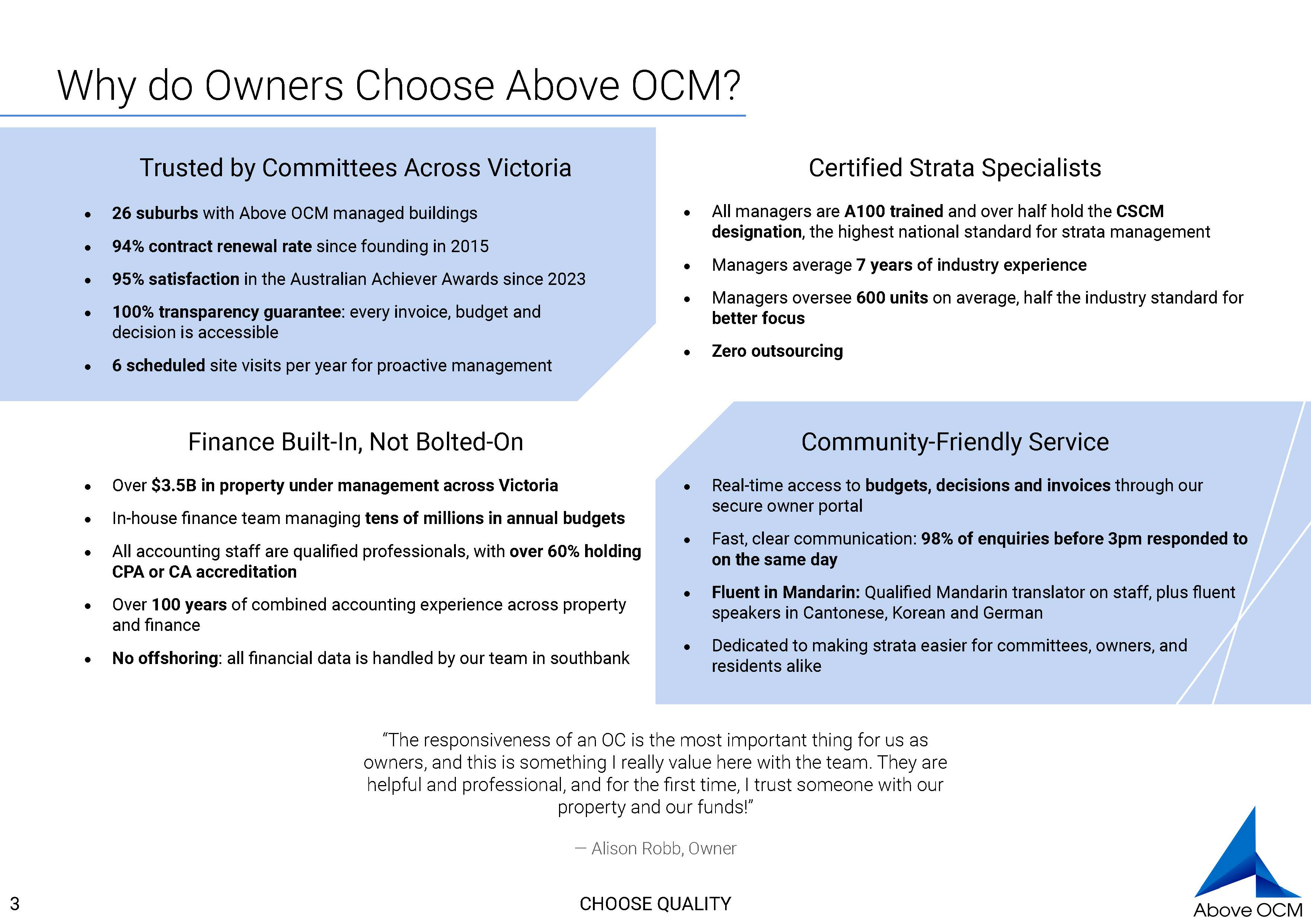
Where competitors used bloated FAQ sections and dense paragraphs, I employed hierarchy and evidence-led sections including case studies, testimonials, awards and data. Service model differences such as manager load, accounting protocols and advanced qualifications were made explicit and explained.
I put real staff on the cover and wrote a human emphasis through the copy, which is also why the tagline became 'We go above and beyond' rather than just 'Above and beyond'. I was surprised by how much of the industry didn't make their materials approachable for laypeople. I think a lot of managers want to seem legitimate by using jargon but many committee members only engage with this stuff a few times a year. When they do, they're generally quite engaged but you need to meet them on their level of understanding. Basically, I wrote the document for committee members rather than industry insiders.
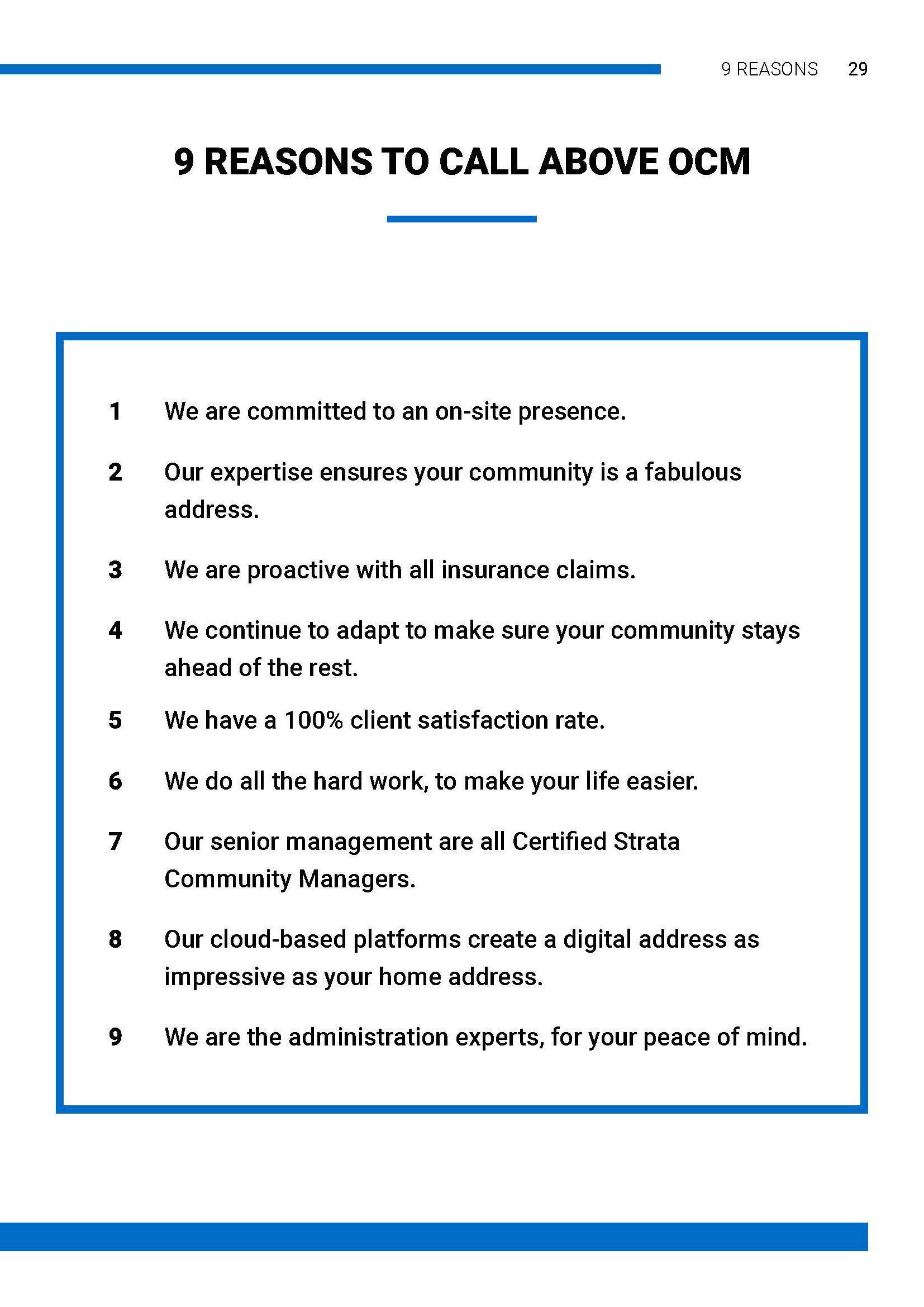
Before
After
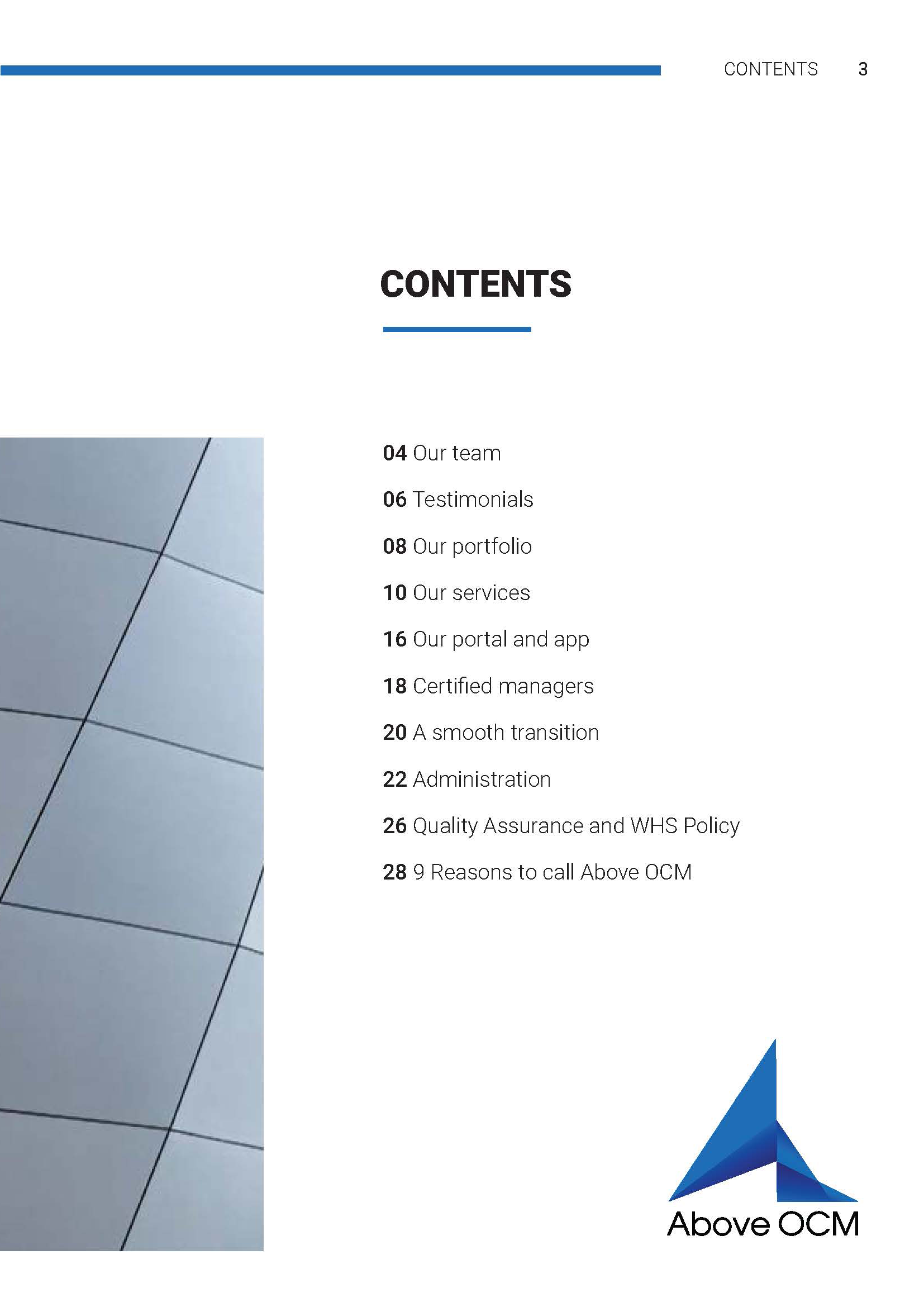
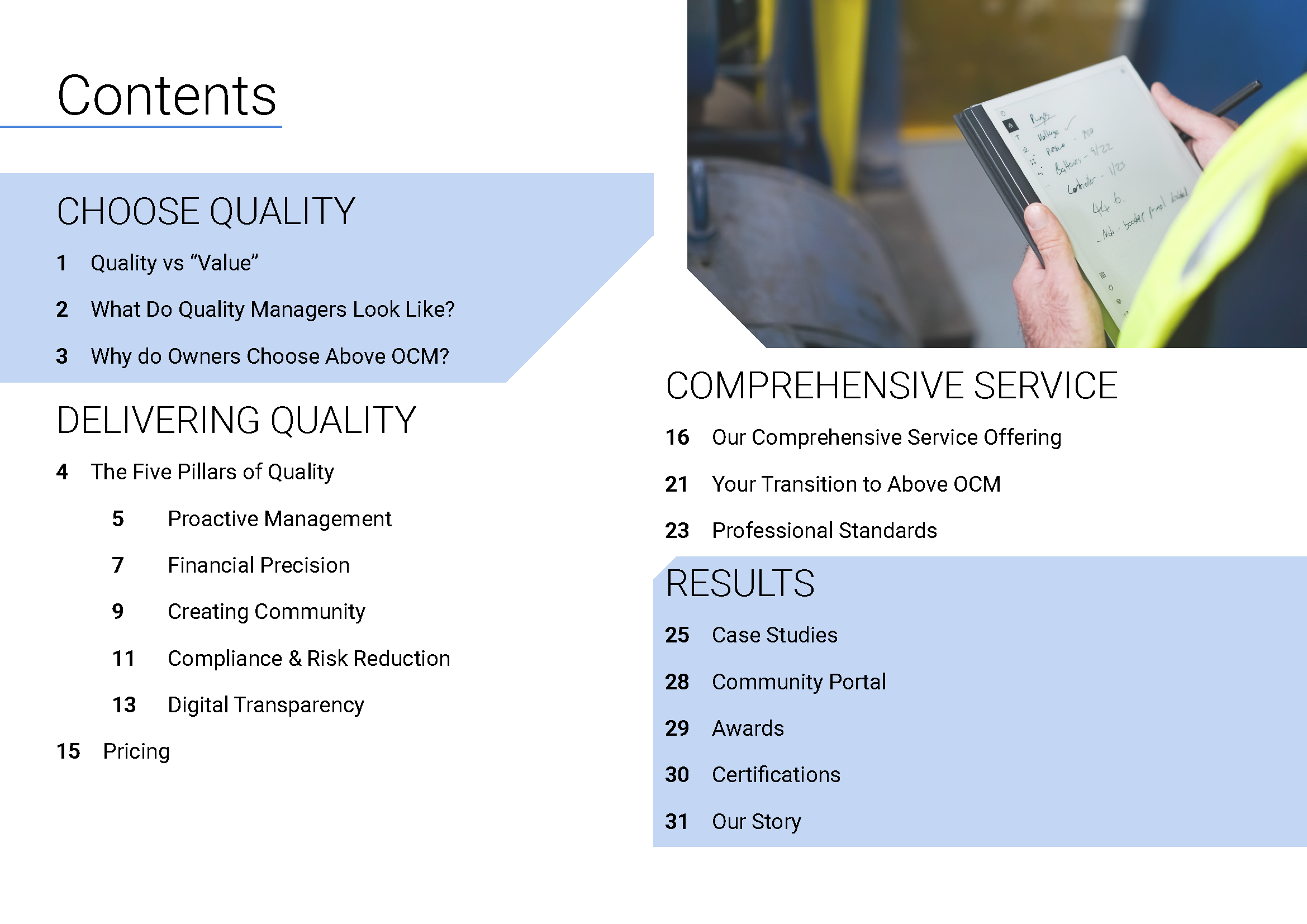
OC firms include an obligatory contents page. It is an obligation but that's no excuse to let it waste the space. The updated document guides the reader through the argument they're about to see, establishes the pace they should expect and identifies the overarching concept that the section will convey. Setting expectations is essential to long form content like this. Without it, readers may be frustrated and unsure where to expect answers to their questions, as well as bored.
I also want to take the opportunity to point out the structural choices like putting pricing in the middle, right after the argument for the quality of service and right before an extensive list of inclusions. Many competitors bosh it on at the end and that creates two problems. It means that the audience can refer to it without being reminded of the excellent service it's attached to and it's also a really reductive final thought to leave them with. If the last thing you show them is the price then it'd better be a pretty damn attractive price.
Before
After
Result:
The proposal has been in use since mid-2025. It moved Above OCM away from fee justification and argued, using our audience's behavioural drives, that they are the right choice. It also brought the depth and perceived authority of the document in line with major competitors, while differentiating the strategic framing.
The client has reported that early results show a significant improvement on the previous document.

